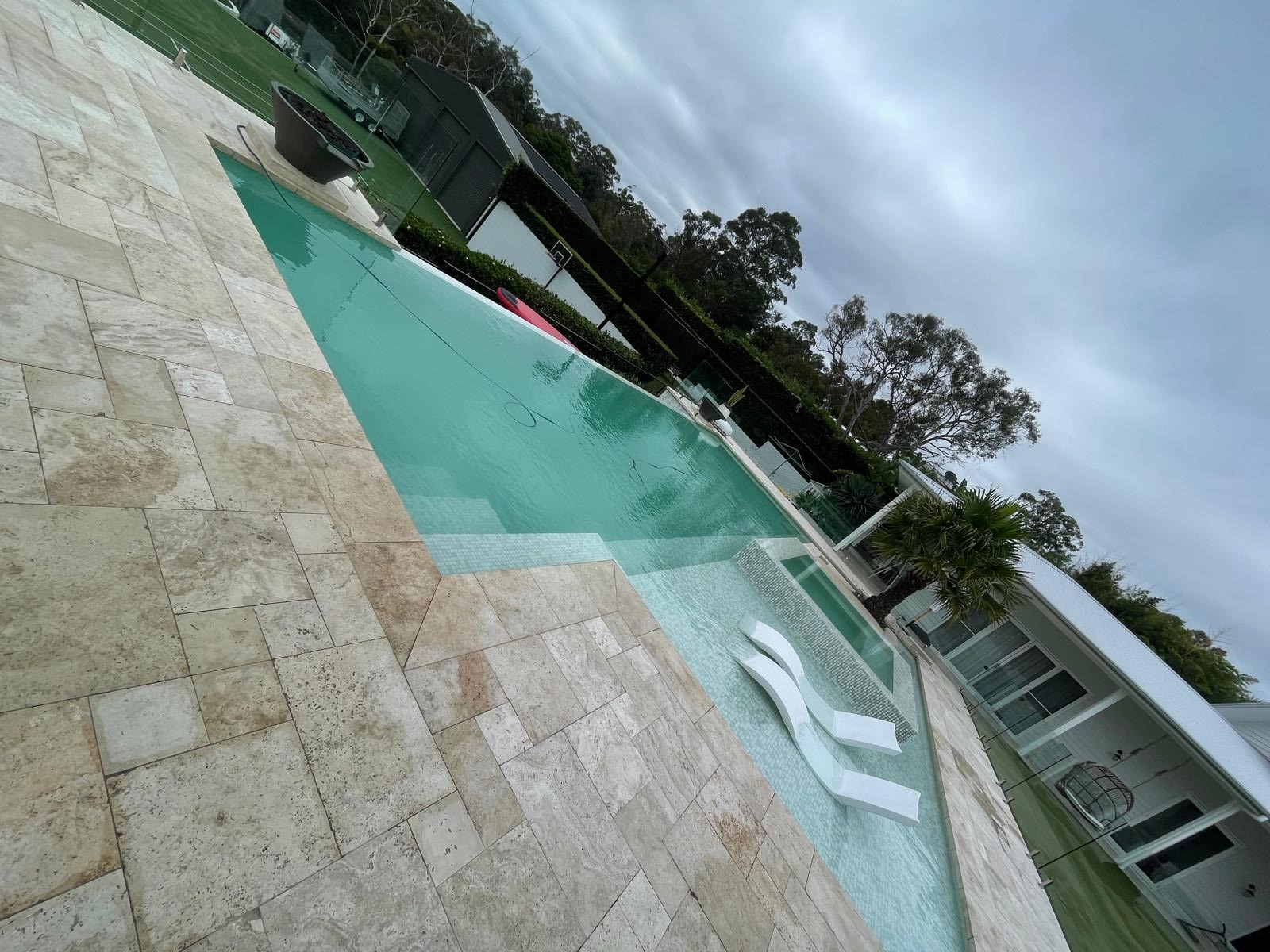
The four pillars of clear water
Every crystal-clear pool you've ever admired runs on the same four systems working together: circulation, filtration, chemistry and cleaning. When water goes dull, cloudy or green, at least one pillar has slipped — and the fix is always found by checking them in order.
The reassuring part: none of the four is complicated. Clarity problems persist because one pillar gets overlooked, not because any of them is difficult once you know what to look for.
Pillar one: circulation
Water that moves stays healthy; water that stagnates invites trouble. Your pump should run long enough each day to turn the entire pool volume over — for most residential pools that means six to eight hours daily in summer, and at least a few hours in winter.
Check the returns: you should feel steady flow and see the surface gently moving. Dead spots — corners where debris collects and water barely moves — often just need a return eyeball aimed differently. Circulation is free once the pump is running; use it.
Pillar two: filtration
The filter is where clarity physically happens — every particle of dust, pollen and dead algae is removed here. A filter under strain announces itself: pressure climbing on the gauge, flow weakening at the returns, water that stays slightly dull no matter what the chemistry says.
Cartridge filters need periodic deep cleans, not just a hose-off — oils and fine particles pack into the pleats. Sand and glass filters need proper backwashing and, every few years, fresh media. If your water has lost its sparkle despite balanced chemistry, the filter is the first place we'd look.
Pillar three: chemistry
Clear water needs chlorine in range (typically 1–3 ppm free chlorine), pH between 7.2 and 7.6, and the supporting parameters — alkalinity, calcium hardness and stabiliser — holding everything steady. pH matters more than most owners realise: at high pH, chlorine becomes dramatically less effective even when the reading looks adequate.
Test weekly in summer at minimum, and after anything that hits the water hard: heatwaves, storms, pool parties. Small, regular corrections keep water brilliant; big irregular corrections create the swing-and-recover cycle that never quite looks right.
Pillar four: physical cleaning
Chemistry can't remove a leaf, and filtration can't scrub a wall. Skimming, vacuuming and brushing remove the organic load before it consumes your chlorine and feeds algae. Brushing deserves special mention — algae begins as an invisible film on surfaces, and weekly brushing disrupts it before it ever becomes visible.
Baskets are the unglamorous heroes: a choked skimmer basket strangles circulation, which weakens filtration, which dulls the water. Thirty seconds with the baskets, twice a week, protects the whole system.
Melbourne-specific clarity traps
A few local conditions catch Melbourne pool owners repeatedly. Autumn leaf fall overwhelms baskets and consumes chlorine faster than dosing keeps up — increase cleaning frequency rather than just adding chemicals. Summer storms dilute and unbalance water overnight — always test after heavy rain. And winter idleness lets invisible drift accumulate, which is why pools 'mysteriously' turn green the first warm week of spring.
None of these are difficult; they just require adjusting the routine to the season instead of running one setting all year.
Cloudy, dull or green: reading your water
Different clarity problems point to different pillars. Cloudy, milky water with correct chlorine usually means filtration — a loaded filter, worn media or insufficient run time. Dull water that isn't quite sparkling often means chemistry drifting at the edges, especially pH creeping up. Green means sanitiser failure and algae — a chemistry and circulation problem together.
This distinction matters because it stops the most common mistake: throwing more chlorine at a filtration problem. If the water is cloudy but tests fine, shocking it won't help — the filter needs the attention. Diagnose the pillar before you treat.
The mistakes that keep water dull
The patterns we see most: pump run times cut too short to save power (which costs more in chemicals and clarity than it saves), backwashing rarely or never, relying on test strips for every parameter, and 'shock and hope' chemistry instead of small regular corrections.
The other classic is the once-a-month mega-clean. Pools don't work in bursts — a week of wind, swimmers and sun undoes a marathon session within days. Little and often beats occasional and heroic, every single time.
How covers change everything
No single accessory protects clarity like a pool cover. A covered pool collects almost no wind-blown debris, loses far less chlorine to sunlight, and keeps its water level stable — three of the four pillars protected at once. Owners who cover consistently genuinely halve their cleaning and chemical workload.
If you do nothing else after reading this article, cover the pool when it's not in use. It's the closest thing pool care has to a cheat code.
A simple weekly rhythm that works
For owners who want the minimum effective routine: mid-week, empty baskets and skim (five minutes). Weekend — test chlorine and pH, dose if needed, brush the walls, check the pump schedule. Monthly — full parameter test, filter pressure check, equipment walk-around. That's the skeleton of every clear pool we service, and it totals well under an hour a week.
Miss a week and the pillars forgive you. Miss a month and they don't — which is why the owners with the clearest pools aren't the ones who work hardest, but the ones who never fully stop.
When clear water still isn't safe water
One final trap worth naming: water can look perfectly clear and still be wrong. Chlorine that's too low doesn't cloud the water immediately — it quietly leaves swimmers unprotected. pH that's drifted high looks fine but irritates eyes and skin and blunts your sanitiser. Clarity is the visible pillar, but safety lives in the numbers.
That's the deepest reason testing sits at the heart of every routine in this article. Trust the water when it looks good, but verify it — clear and balanced is the goal, not just clear.
Cloudy water after storms: the Melbourne ritual
Every Melbourne pool owner knows the pattern: a summer storm rolls through, and the next morning the pool looks tired. Rain dilutes sanitiser, dumps organic matter, and unbalances pH in one hit — and warm post-storm days give algae everything it needs to capitalise.
The ritual that prevents it: after any heavy storm, test within a day or two, restore chlorine and pH promptly, empty baskets of the wind-blown load, and give the filter an extra cycle. Fifteen minutes of post-storm attention prevents the week-long clarity battles that follow storms ignored.
Filtration upgrades that pay for themselves
If clarity is a recurring battle despite good habits, the filter itself may be undersized or past its working life. Upgrading tired sand to glass media, or an undersized cartridge to a larger element, often transforms water clarity overnight — the chemistry was never the problem, the hardware was. We assess filtration capacity as part of any persistent-clarity callout, because polishing water through a worn filter is a battle nobody wins.
The shortcut
If you'd like permanently clear water without managing four systems yourself, that's exactly what our maintenance visits do: test and balance the chemistry, clean the pool end to end, and keep circulation and filtration healthy — on a schedule, every time. Request a quote with a few photos and we'll recommend the right plan for your pool.
Talk to Melbourne's pool care specialists.
Cleaning, maintenance, equipment repairs and heater installation across Greater Melbourne.