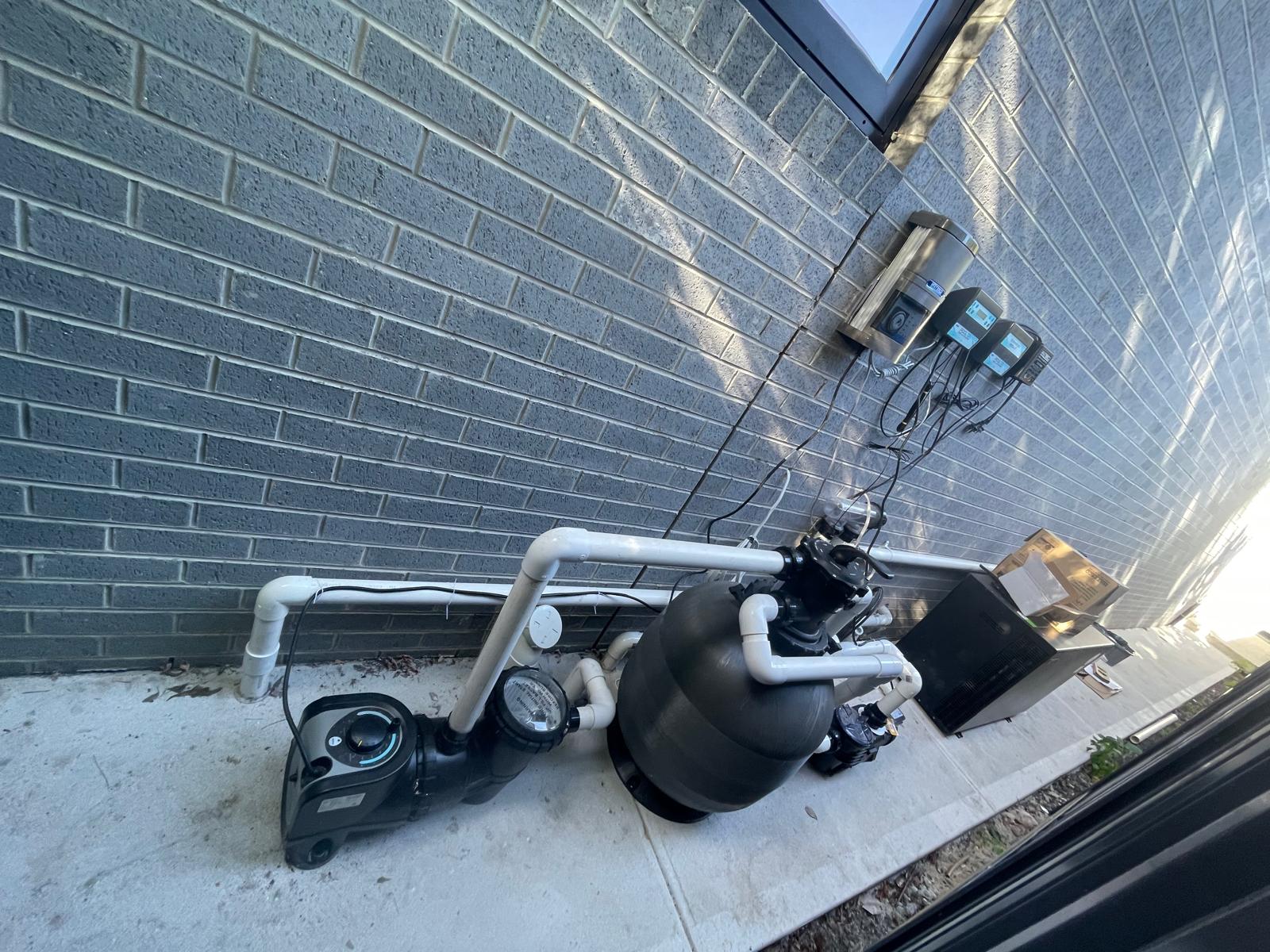
Why pumps matter more than any other equipment
Everything in your pool depends on circulation. Filtration, chlorination, heating, even chemical distribution — all of it stops when the pump stops. That's why pump problems cascade faster than any other equipment fault: a dead pump on a hot week becomes a green pool within days.
The good news is that pumps almost always warn you before they fail. Learning the warnings — and acting on them early — is the difference between a modest repair and an emergency replacement plus a green pool recovery.
The seven warning signs
If any of these sound familiar, your pump is asking for attention:
- Screeching or grinding — worn motor bearings; they only get louder and closer to failure
- Humming but not starting — often a capacitor or seized motor
- Visible water leaks — a failing shaft seal dripping onto the motor below
- Losing prime or refusing to prime — air leaks, blockages or worn internals
- Weak flow at the returns — impeller wear, blockages or failing motor
- Tripping the circuit breaker — electrical faults that need immediate attention
- The pump feels hot or smells hot — overheating motors are close to burning out
The leak you should never ignore
Of all the warnings, a leaking shaft seal deserves special attention because of where the water goes: straight along the shaft into the motor bearings. A seal is an inexpensive part. A motor destroyed by seal leak water is not.
If you see water under or around the pump, turn it off and book an assessment. Running a leaking pump doesn't buy time — it converts a small repair into a large one, sometimes within days.
Priming problems and air in the system
A pump that won't prime — or that shows a churning mix of air and water under the lid — is sucking air from somewhere: the lid O-ring, a union, the skimmer weir, or a water level that's dropped below the skimmer. Air in the system means poor circulation and a pump working against itself.
Check the simple things first: water level mid-skimmer, baskets clear, lid O-ring clean and lubricated. If air persists, the leak needs tracing — pressurised testing finds suction-side leaks that are invisible otherwise.
Repair or replace? The honest framework
Not every pump fault justifies a repair, and not every fault means replacement. The decision comes down to three factors: the pump's age, what's actually failed, and how the repair cost compares to a modern replacement.
As a working guide: pumps under five years old with seal, capacitor or bearing faults are usually worth repairing. Older pumps with motor failures, cracked housings, or a history of repeated faults are usually better replaced. We always show you both paths with real numbers before you decide.
The case for variable-speed when replacing
If replacement is the answer, a variable-speed pump deserves serious consideration. Single-speed pumps run at full power whenever they're on; variable-speed pumps run filtration at low, quiet, highly efficient speeds for most of the day and ramp up only when needed.
The electricity saving is substantial — commonly the largest single energy saving available in a pool — and slower filtration actually cleans water better. For most Melbourne pools, a correctly sized variable-speed pump pays back its price difference within a few summers.
How long should a pump last — and what shortens it
A quality residential pool pump typically delivers seven to ten years of service. The variables that decide where your pump lands in that range are mostly within your control: balanced water (corrosive water attacks seals and internals), clean baskets (starved pumps run hot), and sensible run times (a pump sized and scheduled correctly isn't working harder than it needs to).
The killers we see most often are unbalanced water eating shaft seals, clogged baskets causing cavitation, and pumps running dry after leaks or low water levels. All three are preventable with routine attention — which is why pumps on a maintenance schedule so often outlast neglected ones by years.
Preventing pump problems
Pump care is mostly about the things around the pump. Keep the water level at mid-skimmer so the pump never starves. Empty baskets before they're packed full. Keep chemicals balanced so seals and internals aren't under chemical attack. And listen to the pump occasionally — you know what normal sounds like, so a change in tone is your earliest warning system.
A monthly sixty-second walk-around of the equipment pad — looking for drips, listening for new sounds, glancing at the filter pressure gauge — catches the overwhelming majority of pump problems while they're still cheap. It's the single highest-value habit in pool equipment ownership.
What a pump assessment involves
When we assess a suspect pump, the diagnosis is systematic. We start with the free causes — water level, baskets, lid O-ring, valves — because they're the most common and cost nothing to fix. Then the electrical side: capacitor, windings, draw. Then the mechanicals: seals, bearings, impeller condition and wear.
That order matters. Plenty of 'dead pumps' are actually twenty-dollar fixes, and plenty of pump replacements sold elsewhere were really blocked impellers. An assessment gives you the actual fault and the actual options — repair cost versus replacement cost — before you spend anything significant.
Don't forget the pump's neighbours
Pump symptoms are often caused by the equipment around them. A clogged filter drives pressure up and flow down, which looks exactly like a weak pump. A suction-side air leak at a union looks like a pump that can't hold prime. Even a stuck skimmer weir can starve a pump intermittently.
It's why we assess the circulation system as a whole rather than the pump in isolation — the fix is frequently elsewhere, and replacing a healthy pump solves nothing.
How pump problems affect the rest of the pool
A struggling pump never struggles alone. Weak circulation means the skimmer stops skimming properly, so debris sinks and stains. The chlorinator's flow switch may cut production, so sanitiser falls. The heater — which needs minimum flow to operate safely — starts faulting or refusing to run. One tired pump can quietly degrade every other system in the pad.
It's the strongest argument for acting on early warning signs: a pump repaired at the noisy-bearing stage protects the whole system, while a pump run into the ground takes water quality, chlorination and heating down with it.
A quick word on timers and schedules
Many pump problems we attend aren't pump faults at all — they're schedule faults. A timer knocked out by a power outage, a schedule still set to winter hours in January, or an automation controller quietly running the pump two hours a day all produce 'weak pump' symptoms: poor flow, dull water, chlorine that won't hold.
Before assuming the worst, check what the pump is actually being told to do. And if the schedule is right but the symptoms remain, that's when the diagnosis above matters — we'll find the real cause either way.
What to do right now
If your pump is showing any of these signs, don't wait for total failure — switch it off if it's leaking or overheating, take a photo or short video of the symptom, and request a quote with the details. We'll diagnose it properly on site and give you a straight answer on repair versus replacement.
Talk to Melbourne's pool care specialists.
Cleaning, maintenance, equipment repairs and heater installation across Greater Melbourne.